



-
1.
Everything you need to know about business plan strategies and how to best plan them.
- 2. What is a business plan and what is it for?
- 3. Here are the 3 ways of understanding a business plan
- 4. Business plan: the faster it is, the greater the chances of entering the market!
- 5. The basic parts of the Business Plan: from market analysis to strategies.
- 6. Business plan strategies: here’s how to best define them.
- 7. Marketing Mix and the 5Ps as a strategy for your business plan
- 8. Strategies for business plan according to Central Marketing Intelligence
- 9. In conclusion
Everything you need to know about business plan strategies and how to best plan them.
There is a lot of talk about creating Business plans for start-ups, new companies which can be digital companies, e-commerce but also physical premises any kind of new business.
Indeed, the business plan is a vital guide both for those, like you, who are opening a business and for lenders-for example, banks-who need data in hand to understand whether that particular project is destined to grind or is a possible failure.
Today we want to talk to you specifically about the business plan for your company, its usefulness, and what business plan strategies you can go about identifying.
We anticipate that in order to obtain an actionable and therefore immediately usable business plan, it is necessary to start with ad hoc market research that can define opportunities, risks, and profits related to entering a particular target market… But enough spoilers: let’s go and see, first of all, what a business plan is!
What is a business plan and what is it for?
A business plan is the first step to take if you want to implement a business idea… And you don’t want it to remain a mere idea!
This is a detailed plan, in the form of a paper or digital document, regarding how the company will pursue its goals and what opportunities are available in a very specific market.
Having hard data helps a future entrepreneur understand how to get to success or, in the worst case, give up due to lack of favorable conditions to implement his project.
Put simply, a business plan, if it is well drafted and based on current data, either helps companies understand how to succeed or prevents entrepreneurs from wasting time and money on a cause that would not actually work.
This is undoubtedly a very important pillar for a company, but before you launch you must take into account that there are different meanings of this plan.
Read also: Business Strategy: why you can no longer do without Marketing Intelligence
Here are the 3 ways of understanding a business plan
Before you jump in and ask for a business plan from the first professional you come across, you should consult amarket research agency that can draw up a business plan suitable for your goals and needs, such as our Central Marketing Intelligence.
In fact, not everyone understands the business plan in the same way, and you may come across a professional who is too academic, one who is too sketchy… In short, you may end up with an unusable document to be locked in a drawer forever.
Why? Because there are 3 main ways of understanding the business plan:
- Academic, with business plans in the form of very long documents of hundreds of pages that go into detailing everything point by point. These plans are especially useful when you have to go and talk to a bank or institutional investor who requires it.
- Business plan only at the financial level, dedicated to simply figuring out how much the business will cost you-so how much money you have to invest, how much you can estimate in terms of profits, and how soon you will break even, that is, break even between income and expenses (and then exceed it). This second type is a somewhat leaner business plan that relies only on numbers.
- Business Model Canvas: this third way of understanding the business plan identifies all the key pieces for your business that you need to put in order and be clear about in order to understand how to move, what will be the engine underneath your business, and, consequently, what will be the costs and revenues (and how they will balance).
Which of these methods do you think you should discard? Let’s see if you can guess.
Business plan: the faster it is, the greater the chances of entering the market!
We can definitely say that the longer, more academic form is less in demand today and especially less useful.
In fact, the time it takes to draw up this business plan (months) is really a lot… In the meantime, the market has changed and you have had your business opportunity blown away!
Today, more than ever, the world is full of ideas. Those who succeed are those who put them into practice right away, at the time when this idea can actually solve a problem and have a market.
So the “trick” is to be fast, much faster than others! The business plan should not be something that holds you back, that makes you take longer to enter the market. It has to be a force that gives you that extra push to come in strong and make a success.
Let’s look at what is critical that there be in an actionable business plan, thus usable in the immediate term for the benefit of the enterprise.
The basic parts of the Business Plan: from market analysis to strategies.
Do you want a really useful Business Plan? Then it is critical that it be practical, because it is used to see if there is an opportunity in a particular market.
Also, if you need funding, it serves to give a clear vision to those who need to trust you, show what you have in mind, the real existence of a market that you may be able to reach.
Here, then, are the main parts of a business plan that is translatable into immediate action:
- the problem
- themarket analysis
- thecompetitive analysis
- Your distinctive value proposition that goes to solve the need
- The strategy with which you want to get to the goal
- the financial statement
- The team part, which is who you are is why you will be able to do all this
Well, of all this business plan, the relevant part is the strategies part.
Business plan strategies: here’s how to best define them.
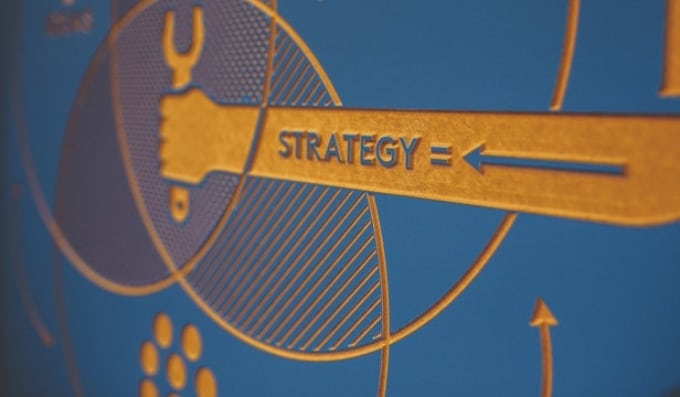
The business plan needs to be practical, not something that then catches dust on a table or remains a forgotten file in the computer. It must be something actionable in the immediate term.
So strategies for business plan must get you there, they must be operational actions that you can actually follow to succeed in achieving the goals set in the financial part of the plan.
How to define strategies? Should they be invented?
Absolutely not!
You have to start with the analysis of the target market in order to understand these fundamental aspects:
- the potential of the market you want to enter
- who your target customers are and what their current level of awareness is (so how much they Google certain products/services on Amazon)
- How customers try to solve problems, whether more informational, transactional, or unconscious
- what online channels the target customer base frequents, then whether to use certain Touch Points, such as social media and other customer acquisition strategies to reach them
Next, you need to study your competitors to understand their strategies for customer acquisition and growth in the market.
If you then have to open an e-commerce or, for that matter, sell products online, with competitoranalysis you can also figure out how much competitors’ sites convert and how much people buy from them on the Web.
Read also: Business plan for ecommerce: start selling online driven by data
You need all this information to create your own strategies of different kinds.
For example, you can adopt the marketing mix strategies with the 4Ps (to which, lately, a fifth has been added) or those that, in our opinion at CMI, are relevant.

Marketing Mix and the 5Ps as a strategy for your business plan
The 5Ps of marketing (it used to be 4, now it has become 5 so as not to overlook a very important element) are exactly the initials of 5 factors: Product, Price, Promotion, Place and People.
These are key elements of marketing used to fine-tune important business strategies.
Known as the marketing mix, these are factors dedicated to satisfying target customers, differentiating from competitors and growing business.
To better understand these elements, here are more details about them:
- Product: refers to the products and services offered by your company and the strategies devoted to their appearance, function, warranty etc. Strategies dedicated to the product are generally based on meeting the needs, wants and expectations of customers.
- Price, or the pricing strategy of a company’s products/services and its influence on customers. The pricing strategy must be perfectly aligned with your business and target market!
- Promotion, that is, advertising activities aimed at acquiring more customers.
- Place (Place), i.e., distribution channels and where customers find products. The place factor is very important so that consumers find products/services in the right place, at the right time… And in the desired quantities.
- People, a factor indicating the company’s personnel.
These are the elements on which you could base your strategies for the business plan, but there are others that we believe are equally relevant.
Strategies for business plan according to Central Marketing Intelligence
As for strategies for the business plan, if you want to be academic you could follow the 5Ps, but if you want to be even more strategic we point out additional avenues to take:
- Target selection strategies. This means that you need to understand and choose the people you are addressing (and understand why you are doing so).
- Defining your distinctive offering compared to your competitors, thus why a customer should choose your company if they possess the needs and characteristics you have identified in your target customers.
- The channels and ways you can reach your customers, which include the channels you choose to communicate with consumers and the message you want to send.
- Product strategies. In the business plan you can also go and define what your strategies will be both at the front end level so first product that you give to the customer and then back end product i.e. the core product that you sell to them when they are already an acquired customer.
- Pricing strategies.
Once you have planned your business strategies, you can think about the financial prospectus. This depends on the financial resources needed to put your project into practice, the estimated market demand, and the costs of the strategies you have adopted, with a profit and loss analysis.
In conclusion
Business plan strategies depend primarily on your market (including customers), your goals, and the costs you can/will/should incur.
Do you want to know how we can help you with the entire drafting of an actionable business plan, therefore translatable immediately into activities to achieve your goals?
Contact us now for a free consultation-we are here to support you in making your dream finally become a business.