



You know that period in life when children, usually between the ages of 3 and 5, are curious about and discover whatever comes their way?
Here, surely you know that at this very stage of their growth, the question they most often ask is,“Why,” followed by “What is it?”
The reason is simple: whatever surrounds them is new, and every day they make a thousand discoveries.
Here, the same thing happens to us at Central Marketing Intelligence when we talk about our business with other entrepreneurs, managers or potential clients.
No, we are not saying that they are children! We are saying that the question we are asked most often is, precisely, “What is it?” In particular, we are asked , “What is Market Intelligence?“ And then, “What exactly do the terms you use mean, such as KPI, CR and so on?
For this reason, we decided to provide clarity by explaining “bread and salami” marketing intelligence terms that we use most often. Read to the bottom of this article to find out about them-or watch our video!
Why is it important to talk “bread and salami”?
Let’s take the example of children again. We said they are constantly asking “what is it?” because they do not know most of the things around them.
In somewhat more technical terms we would say that they are not aware. Just as our potential customers are not, to whom we have to explain what we do at the Central Marketing Intelligence .
But if this is true, then when we talk to them, we should take this into account and try, accordingly, to communicate with them in an extremely simple and clear way.
Then again, try to think about when a 5-year-old asks you what a “plunger” is. Surely you are not going to tell him that it is a mechanical tool used to clear clogs in pipes (as Wikipedia cites). Instead, you will try to explain it in a much simpler way, with much less complex terms!
The result will be more or less, “The plunger is something you use to clean the sink when the water gets stuck.”
We agree that the message is not 100% technically correct … but the likelihood that the child will understand more is definitely higher.
The same goes for your potential clients.
Don’t misunderstand-we’re not saying you have to treat your potential clients like children! We are just saying that when you talk to them you have to think that there are people in front of you, who have a vague idea of what you do .
Your goal?
Make them understand what you are saying! Especially if you are doing a sales negotiation!
This, in other words, means that you should not use technicalities, industry-specific words because otherwise you risk not being understood!

Market Intelligence definition: why we tell you about it!
Back to us, what does this have to do with Market Intelligence: definition of the 9 most used terms?
As we have already told you, very often the entrepreneurs or managers we talk to have asked, “What is Market Intelligence?”
This and many other similar questions (such as, “ What is Big Data? ” or “ What is the difference between Market and Marketing Intelligence? “) led us to assume that, in fact, the level of awareness of our target customers on these topics was low.
At that point then to confirm our hypothesis with reliable and certain data, we decided to do a careful analysis of the target, following our Market X-Ray method.
What has transpired is extremely interesting!
Not only our target audience but also most Web users are not familiar with these issues!
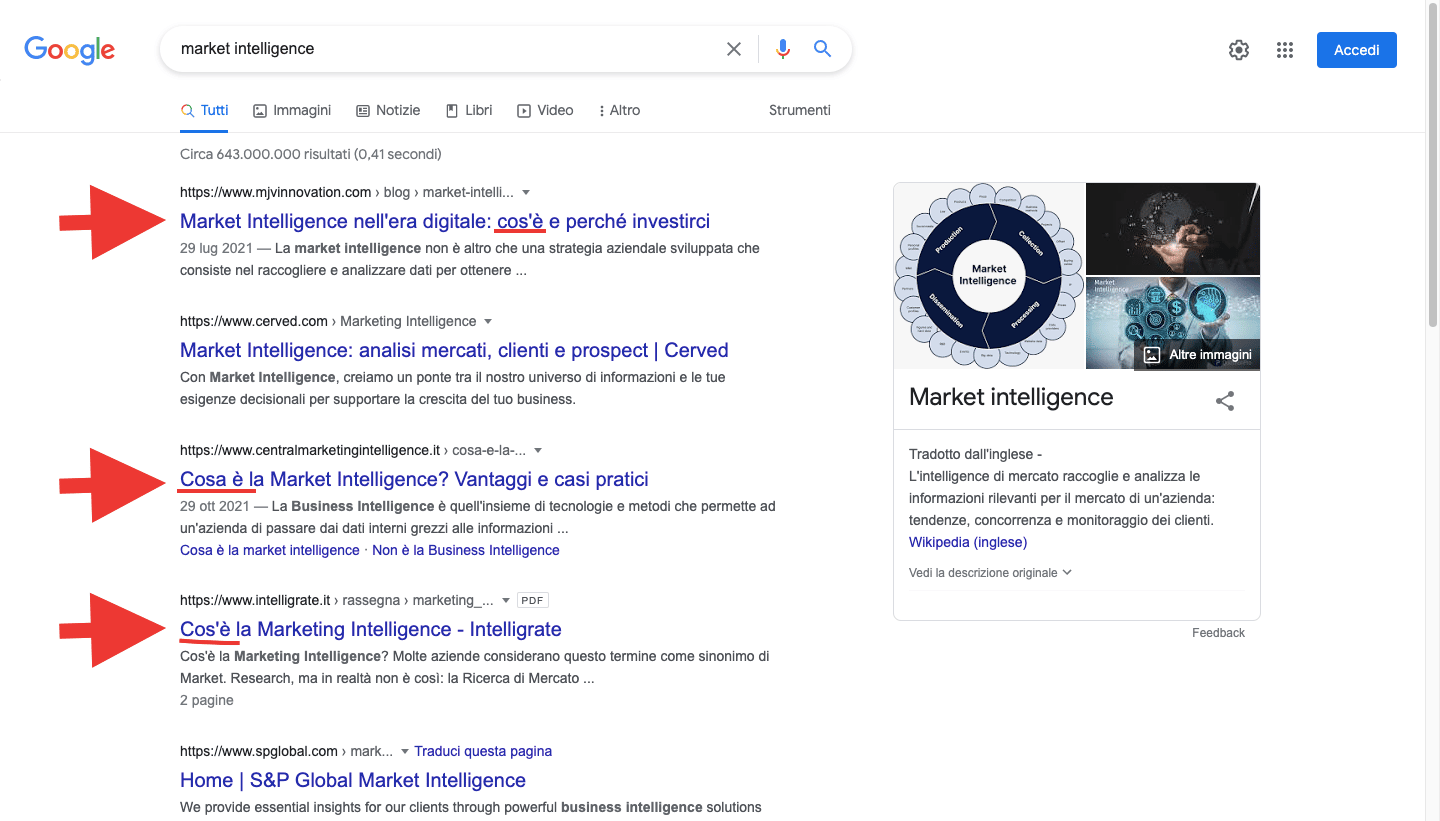
To guess this, it is actually enough to analyze the first results of Google’s SERP.
As you can see in the image below, if you type “Market Intelligence” into the search bar among the first four results, at least three focus on answering this very question.
Hence the idea of explaining what exactly Market Intelligence is!
However, in this article you are reading, we do not want to give you the definition of the term (which you can still find in “What is Market Intelligence? Benefits and practical cases“), but rather we want to explain in a simple way (bread and salami indeed) the 9 most used terms of Market Intelligence.
The reason is simple: as we said before to make sure your customers understand what you are saying, you have to speak simply and easily understood.
Market Intelligence definition: what are the 9 most commonly used terms?
So let’s see together what are the 9 most common and most searched terms that you can’t not know about Market Intelligence, explained bread and salami!
Big Data
Big Data are the data that are tracked by computer systems and are present in such large quantities and characterized by speed and variety that they require advanced processors to analyze.
Doing so allows us to detect patterns, patterns that the single piece of data would not allow us to detect, allowing us to uncover what we call “insights,” information at a higher level that is accessible through the big picture.
Big Data is not just something for nerds or techies: it is all around you and can directly affect your business. If you want to understand practical examples of Big Data, watch this video on our YouTube channel!
If you want to learn more about these topics:
📹 YouTube video – “ What is Big Data online “
📖 Article from our blog on the topic –“Big data, what it is and who needs it from a Business perspective“
Web and Social listening
Do you know this term instead? It is the ability through dedicated software to be able to track everything that is written on social media, forums and blogs about a particular topic. Thanks to Social Listening, or in Italian “listening to the network,” you are able to understand how much is being talked about and especially in what way.
This is a key issue for us at CMI, because thanks to network listening software, it is possible to explore the online world that we call “talk data,” of conversation, that is, all the texts published online on a topic or field.

If you want to learn more about these topics:
📹 YouTube video – “ What is Social Listening “
📖 Article from our blog on the topic –“Social listening: what it is and why you should listen to the network“
Mention, Mention or Verbatim
They are synonyms for the single conversation, review, content that talks about a certain topic and that together go to constitute the so-called Brand Reputation, i.e., the reputation of a certain brand or a certain topic.
Every single “mention” or “verbatim” can be tracked through social listening and can be an opportunity to intercept who is taking an interest in a certain topic, a specific product, or your brand!
If you want to learn more about these topics:
📹 YouTube video – “ Brand Monitoring: how to do Online Reputation Monitoring. “
📖 Article from our blog on the topic – “ Brand reputation monitoring: does “as long as it’s talked about” really apply on the web? “
Market Trend
This term means market trend, change over time of an element that influences a certain industry.
In simple words, it means going to take a topic, a theme, a phenomenon in the market and going to look at it over a very large time interval to see how it is evolving, whether there is seasonality and whether it is increasing or decreasing in importance. There are several software tools to do this, one of them being Google’s free tool, Google Trends.
Or, moving backward means looking at an industry today and understanding what trends are taking place that are influencing it and therefore can be explored in depth, to understand how to fit into the trend, taking advantage of the opportunity, or how to avoid a potential threat.
If you want to learn more about these topics:
📹 YouTube video – “ Google Trends tutorial: why it is critical for market research “
📖 Our blog article on the topic –“Google Search Trends: 5 useful answers for your Company that you can get by leveraging Google Trends data“
Intelligence Tool
This is the way to go about pointing out programs and software that allow us to go and track data, analyze it and even display it as is most appropriate.
To date, there are thousands of online software created to track and analyze different types of data. Most of the Big Data that is useful to businesses now can be accessed through tools that make it easy to query … leaving the user “only” to interpret the results.
Indeed, remember that Intelligence Tools, like all software, are enablers: they are not enough to find answers just by clicking a button, but they are the “brush” with which we can draw our “picture”!
If you want to learn more about these topics:
📹 YouTube video – “ Marketing Intelligence: here are 8 types of tools you can use! “
📖 Article from our blog on the topic –“Marketing Tools: 3 free tools to unearth customers perfectly in Target“
Dashboard
It is the most relevant set of charts and indicators that gives you access to all key information in just a few clicks.
So these are true dashboards, visualizations that allow you to view aggregated data, segment it, and keep track of it wherever you are.
If you want to learn more about these topics:
📖 Article from our blog on the topic – “ Amazon market research tools & research: the dashboard you don’t have to do without “
Buyer Personas
Also called the “avatar of your ideal client,” this term denotes the set of demographic, psycho-graphic, and interest characteristics of your ideal client .
Are you wondering how to define your buyer personas? We give you the answer: you obviously need to do ananalysis of your target audience!
If you want to learn more about these topics:
📹 YouTube video – “ B2B target customers: 3 methods to identify, study and reach them, thanks to data! “
📖 Article from our blog on the topic –“Target audience analysis: what it is and why it is central if you intend to acquire new customers“
🎓 Video course in our CMI Academy – “ Online Customers “
Customer Journey
This expression denotes all so-called touch points, i.e., online and offline contact points, which
your customer must go through during the purchasing stages.
Today, in fact, the customer’s journey is increasingly complex: they do not just walk into a store and buy, as they did in the past, but use different devices, move from site to site and from online to offline as they consider whether and what to buy.
Therefore, Customer Journeys become “omnichannel” and must be studied thanks to online data, both internal to the company (thanks to web analytics) and external (thanks to Intelligence Tools!).
If you want to learn more about these topics:
📹 YouTube video – “ Customer Centricity: putting the customer at the center through Data “
SWOT Analysis
It is the strategic matrix that allows you to collect all the information that has emerged during a market research, bringing order to the information gathered to bring out what really matters.
The term stands for two internal areas within the company, such as S=Strengths, strengths, and W=Weaknesses, weaknesses, and two external areas, such as O=Opportunities, external opportunities, and T=Threats, threats from the market.
By combining these elements, you manage to get the full picture of the scenario in which you operate.
Conclusions
As you can see, these terms open up worlds that we could delve into almost indefinitely … but which today are more crucial than ever for any kind of business that wants not just to get results, but simply to survive.
Our goal at Central Marketing Intelligence is to help you understand in a simple way, bread and salami in fact, what seems seemingly hostile and far from the reach of companies, entrepreneurs and managers.
If you have been following us for a while you may have heard us say that our goal is to “democratize data” and market intelligence in general. We want them to no longer be the prerogative of the few, the big players or the American multinationals, but to enter the jargon and the mindset, the way of thinking even of those who do business in Italy.
That’s why we created our CMI Academy, the training school to help business people think with data, where we help you discover methods and software to take control of your business.
And that is why every week on our YouTube channel we post a new video that explains these concepts in a simple way.
So. is there any other term you would like to see explained in this article? Write about it in the comments!
And if you think you need a discussion on how to start basing your decisions and strategies on data, please feel free to contact us by clicking on the banner below 👇.
You will speak with a Market Intelligence expert from our CMI Team, who will help you understand what the next steps are in your case and whether we can help you practically!
