



Watchword: Sustainability! How many times do we hear it mentioned by so many people?
In addition to being on everyone’s lips, this term fills newspapers and, let’s face it, is also very cool. Everyone today is talking about sustainability, Green Marketing, green transition, and how important it is for companies to become sustainable.
But are these just rumors or does this represent a real trend?
We need to make a small disclaimer at this point: by “real trend” we mean actual consumer interest in these issues, such that they are buying more or prefer those companies that actively seek to be green.
In a nutshell, we ask whether being green can bring a concrete revenue benefit to your company or whether all this attention to the issue is just a passing fad.
Obviously, to answer this question we need data, accurate and reliable. In particular, we need to analyze what the sales data tell us.
Read on to learn how you can increase your data-driven revenue through green marketing.
Green Marketing: what the data tell us
Let’s start with two pieces of data:
- According to GreenItaly’s 2021 Report, in the year 2020 among companies, which made sustainability investments, 16 percent managed to increase their turnover in 2020 compared to only 9 percent of non-green companies.
- after the pandemic, 71 percent of consumers seek to make more informed choices when shopping. Specifically: 67 percent of people try to reduce plastic consumption; 63 percent reduce emissions; 57 percent try to buy zero-mile products.
So far, so good, the situation seems clear: if a company is committed to being green, its revenues increase because in fact consumers are looking to buy more sustainable products or services.
But is this really the case? Let us look deeper into the data and discover the dilemma that plagues both the consumer and the modern entrepreneur.
Green Marketing: we unravel the dilemma with Market Intelligence!

Even today in many industries such as, for example, in the fashion industry, when the customer is faced with a choice between buying an eco-sustainable garment and a regular one, more than89 percent prefer the traditional garment.
The main reason? Simple, the price!
In fact, the modern consumer’s dilemma is just that: do I buy the green product/service that costs more or the “normal” one that costs less?
Well, the issue is complex.
Research for the food sector, for example, shows that 68 percent of consumers are willing to pay a little more for green products as long as the price difference is really marginal. In contrast, 18% say they still choose based on the lowest price and do not consider it relevant that the product is sustainable.
In this regard, in fact, even the report by Capterra tells us that of the 30 percent of consumers who indicate that sustainable measures have little or no influence on their choice of products or services, as many as 56 percent say the reason is precisely the generally higher price of these products.
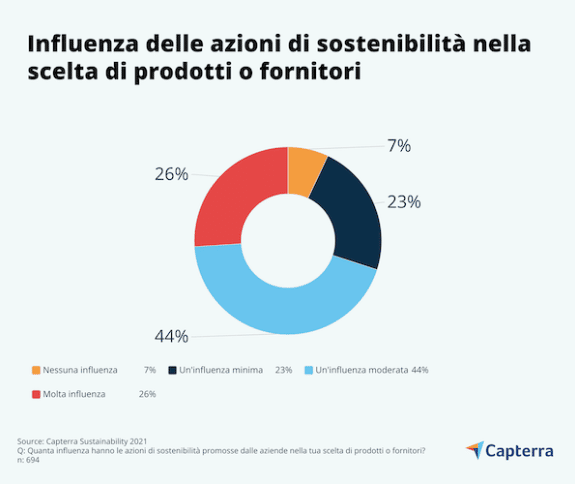
Reading this data, as an entrepreneur, business man or woman, or manager, will probably make your despondency rise!
You’re almost certainly thinking: “If I make my business more sustainable and follow the trend of the moment, I will definitely have an increase in costs. But if costs go up, I have to raise prices so as not to eat into my profits. The data, however, tell me that consumers will not buy if the price is higher. But so what should I do?”.
Here, then, is clear the dilemma for the modern entrepreneur!
But how to solve it? How can a company harness the tangible benefits of the so-called 4 R’s of green-that is, reusing, reducing, recycling, and refusing-if customers are not yet so ready?
A solution can come to us from the Data!
The solution to the dilemma that plagues many entrepreneurs today is given to us by data!
By reasoning in a Data Driven way, companies can first understand what factors customers are really willing to pay a price difference for.
If, for example, in food, consumers are not willing to pay a premium price for a more sustainable product, they might be willing to pay a premium price for a product with better nutritional characteristics.
The same applies to the management of the entire production chain. By tracking with the right monitoring systems, more “sustainable” supply chains can be created. For example, reducing waste due to too many steps and, why not, choosing only suppliers who implement best practices for being green.
Another source of waste is caused by unsold products, kept in stock and in many cases disposed of still in perfect condition, because it is cheaper to dispose of them than to pay the cost of keeping them stored in stock.
Data can help avoid this: by studying seasonality, production can be synchronized with demand, avoiding times when unsold items prevail. In addition, with data and the right tests, it is possible to launch products based on customer needs and understand in advance whether a product will really have a market.
Also read“Target analysis: what it is and why it is central if you intend to acquire new customers“
In conclusion
Solving the modern entrepreneur’s dilemma today is possible, and it is equally possible then to do green marketing by increasing revenue. To achieve this, however, you must rely on data and Market Intelligence .
It is only by leveraging a Data Driven approach, in fact, that you will be able to address the green transition and thus meet the growing need of consumers to be greener.
By doing so, you can buffer the increase in costs incurred to become more sustainable, which usually occurs in the short term, without necessarily increasing the final price of your product, service to the consumer.
This way, moreover, thanks to the data you will be able to achieve the benefits of the green transition (which are usually achieved in the long run) immediately and at the same time increase your customer’s satisfaction in buying your products/services.
As you see then, leveraging a Data Driven approach to address the ecological transition has enormous benefits. Said like that, however, it all sounds very simple. Actually, the issue is a bit more complex.
In fact, the prerequisite for gaining all these benefits is to have full control of your internal and external data.
But how to go about getting it?
This is where, in fact, our online Big Data experts from Central Marketing Intelligence come in, who through Market Intelligence help you track, monitor, analyze, and translate your data into actionable insights to address the green transition successfully!
So, don’t waste any more time! Contact us and take control of your data to overcome the modern entrepreneur’s dilemma with Market Intelligence!