



Artificial intelligence is shifting from an emerging technology to an integral part of our daily lives. We see it in healthcare, transportation, education, and financial services. It’s a silent yet profound transformation that is rewriting the way entire systems operate.
The business world is no exception: AI is entering processes, simplifying them, accelerating them, and making them smarter.
A concrete example is market research, where the sheer volume and complexity of data make AI a valuable tool for working better, faster, and with greater depth.
But what can AI really do for those involved in strategic analysis?
Three areas where AI improves research
Faster and more targeted data collection
Artificial intelligence can sift through sources, online data, and documents in a fraction of the time. This speeds up the exploratory phase and immediately increases both the quantity and quality of available information.
Faster and more in-depth analysis
Well-trained AI models can process large volumes of data, detect trends, identify signals of change, and spot anomalies. This enables analysts to gain a broader, clearer, and more up-to-date view of the market context.
Discovery of patterns and strategic insights
One of AI’s real strengths is its ability to identify connections between seemingly unrelated data, providing valuable insights for building more targeted and flexible strategies.
We at CMI are also experimenting with new integrations
With the goal of further improving the effectiveness of our analysis work, we are integrating artificial intelligence into our processes. We have developed an internal Smart Assistant designed to support our team during the intelligence phase.
This AI agent does not replace analysts’ work but enhances it: it saves time in operational phases, freeing up resources for the more strategic and interpretative aspects of the job.
A project supported by the PR FESR FVG contribution
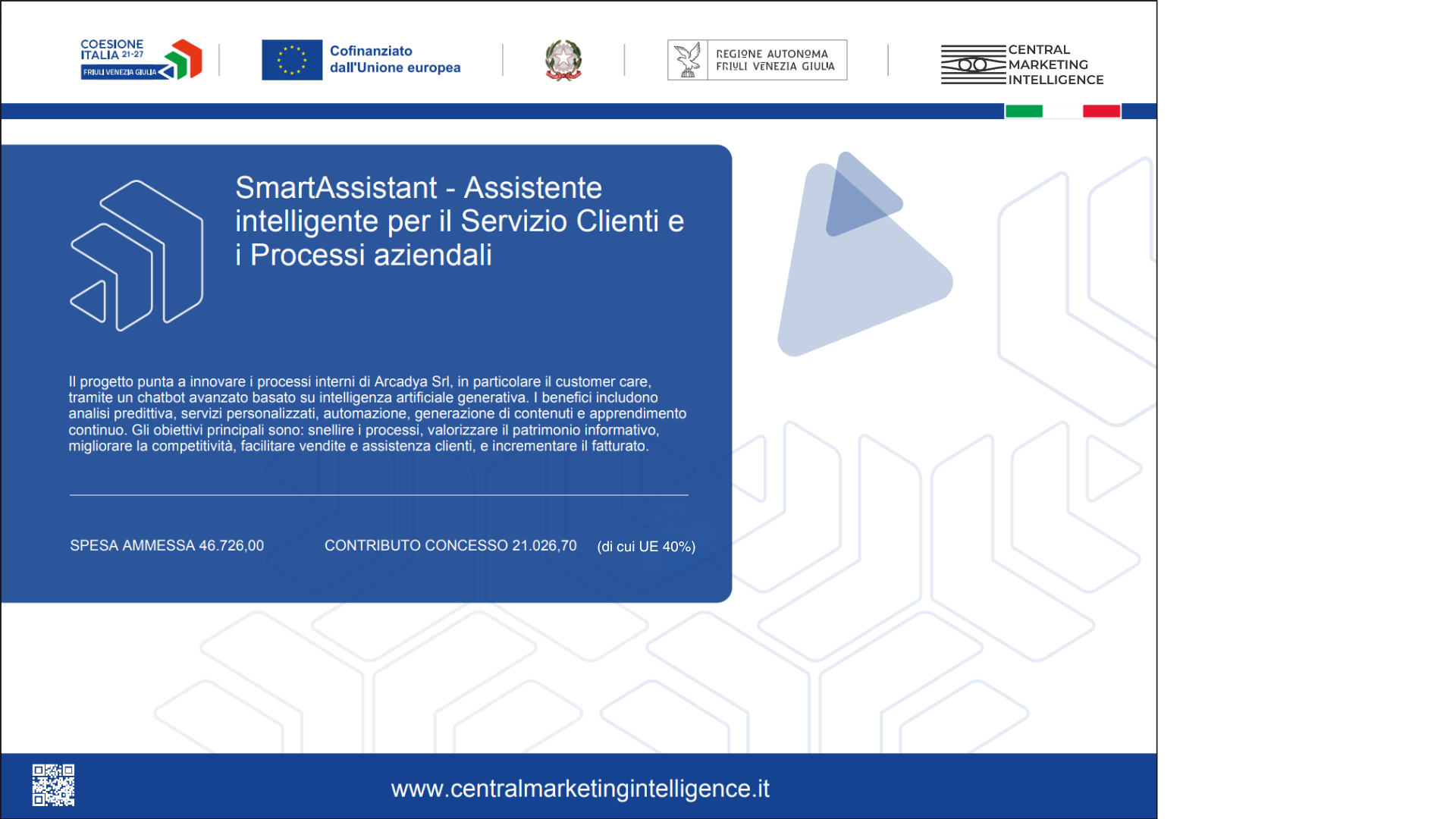
The first phase of the project to integrate artificial intelligence into CMI’s research processes was carried out with the PR FESR FVG contribution of €21,026.70, 40% of which was co-financed by the European Union.
The initiative aims to innovate Arcadya Srl’s internal activities by leveraging its information assets, improving process efficiency, and strengthening business competitiveness.
Specifically, the project involved developing an advanced virtual assistant powered by generative AI, designed to support the team’s intelligence activities through automation, predictive analysis, workflow customization, and content generation.
The main objectives of the project are:
- streamline internal processes,
- enhance the company’s information assets,
- improve competitiveness,
- support sales and customer care,
- increase revenue sustainably.
A concrete step toward a more advanced research model, combining the precision of technology with the value of human analysis.
Toward a new research standard
Artificial intelligence is not a trend. It’s a structural change in the way information is managed and interpreted. At CMI, we believe AI’s true value emerges when it serves human expertise—not when it replaces it.
This is just the beginning. We will continue to explore, test, and develop solutions that allow us to deliver research that is increasingly smart, useful, and action-oriented.